- cross-posted to:
- selfhosted@lemmy.world
- selfhosted@lemmy.world
wtf
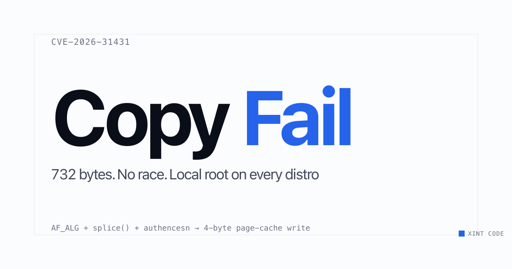
An unprivileged local user can write 4 controlled bytes into the page cache of any readable file on a Linux system, and use that to gain root.
If your kernel was built between 2017 and the patch — which covers essentially every mainstream Linux distribution — you’re in scope.
how does that only get a CVE score of 7.8, the impact of this is huge
Probably because the attack vector is having a user account on the target
Exactly. It’s Yet Another Privilege Escalation Vulnerability. Unless you’re dealing with a multiuser machine, the attacker first needs to use some other vuln to get into an unprivileged account. Without that additional vulnerability, this exploit is useless.
some other vuln
You mean like inveigling it into a pypi or npm or whatever package? Checks out.
That’s privilege escalation for you. 7.8 is pretty high.
The Python script to check if you are vulnerable is extremely suspicious and hard to decipher.
It’s a bit strange that this code requires a binary blob to verify, I think people who want to experiment with this should take some caution as it could be an exploit-in-an-exploit (user is highlighting a real exploit, but also trying to take advantage of people testing by effectively installing a back-door.) I won’t say that’s happening for sure, but take running this yourself with extreme caution.
BLOB already includes “binary”. That’s what the first B is for.
Sorry, couldn’t stop myself.
I had always heard “binary blob” said when it came to opaque code, but I see that blob is what is used to describe unexplained binary data as a whole in database lingo, so I’m willing to say your usage of it is probably more correct than mine here, assuming the binary data isn’t an actual program (afaik there’s no elf-file like characteristics but who knows.). 😇