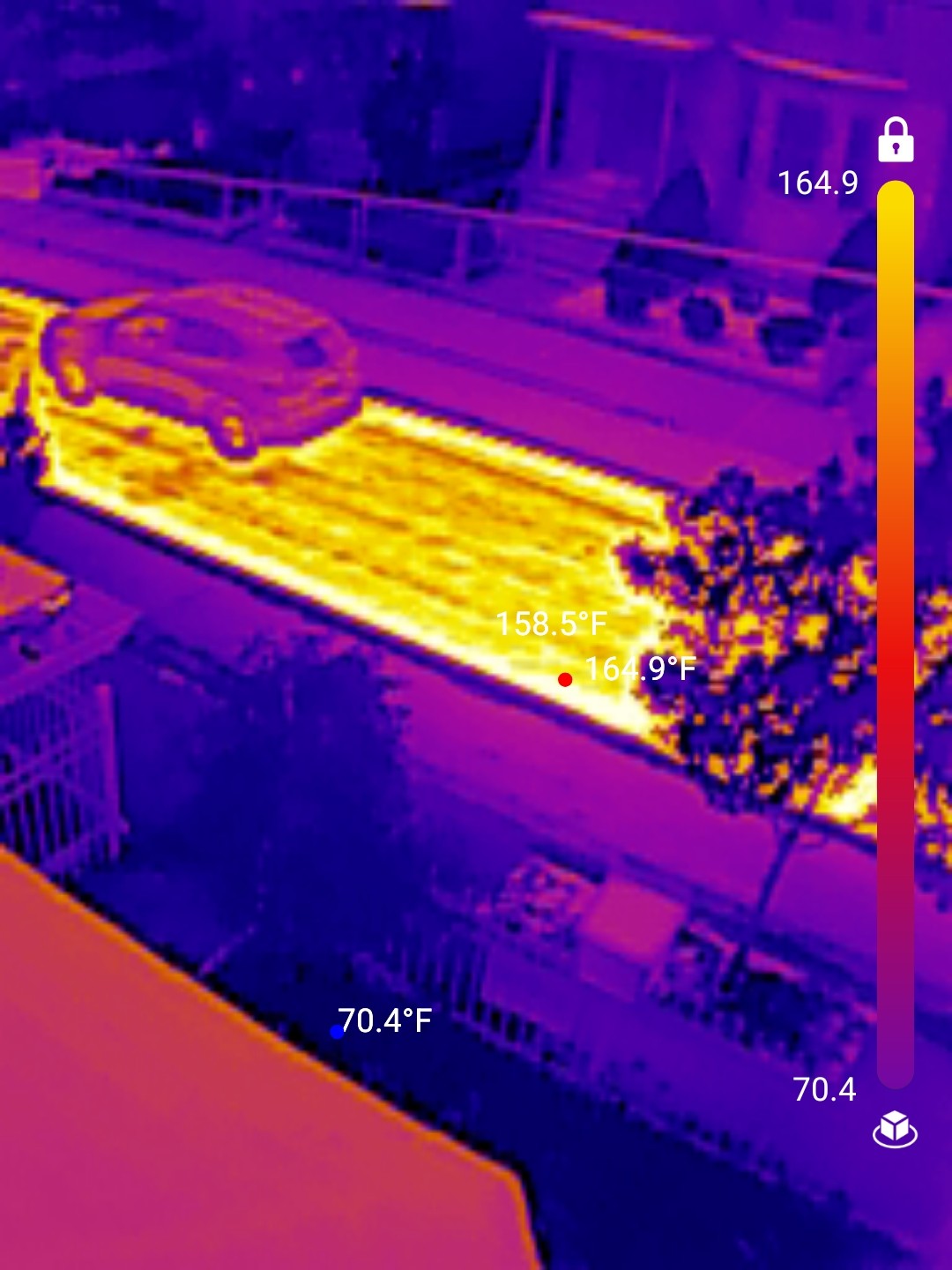
I could feel the heat coming off it when I stood next to the repaved section. They didn’t repave the parking area at the edge. Opened to traffic again, seems firm enough to drive on at 160⁰F.
160F = 71C for the freedom challenged among us.
Seems crazy hot to open up for traffic tho.
Geez I hope they put up no pet signs. Would hate for someone to let their dog walk on this.
Since summer is coming in many parts of the world, I’ll include a psa about asphalt temps being well above air temps. Good chance if you are enough of a nerd to be on Lemmy you have a laser thermo probe somewhere. Consider bringing on your walk and checking some pavement temps. Avoid walking dog if >115f 46C
I just touch the pavement with my hands every time the road surface changes. If I can’t hold it there comfortably for a few seconds my dog is not going on it.
I have run my dog on pavement when it’s in the 90s, and in full sun at midday, and myself went barefoot too, and it’s bearable if you keep moving. Dog pads are even tougher, but obviously 90s are different from the hundred and teens it’s never been that hot here. It’s rare for it to get to 100 in any year here.
Just check the pavement retained heat can make it quite hot if it’s getting into the 90s. It can be hard for dogs to regulate their core temp in air temps in the 90s too.
Neat, you can also see where people’s tyres have absorbed some of the heat.
Lol, no. Tires momentarily contacting hot asphalt while rolling on it will not significantly lower the surface temperature of hot asphalt. The road paving process produces T⁰ unevenness while spreading asphalt … notably because of flow of asphal from the uneven T⁰ in truck loads waiting typically 1 hour before being dumped … then carateristincs of flow in the paving machine … and … civil ing. … whatever.
Edit : i blocked one user below ( prenatal_confusion@feddit.org ) ; they couldn’t understand anything technical that i was explaining and they wanted to spark some conflicts.Doesn’t explain the pattern.
i gave only the basics. From those I could explain the pattern or someone could think about it very hard and understand how the pattern is created.
Oof you are very sure of yourself.
Regarding the asphalt: If there is a delta in energy level in matter then it will even our until an equilibrium is reached.
How could this apply here? When a car tire rolls over the fresh asphalt it wouldn’t rest a long time in one spot but it would definitely absorb some energy during contact. Since it is rotating and contacting the road it is reasonable to assume that there is would be a decent amount of heat transfer. Wind or air cooling of the tire doesn’t seem like a significant factor here. But that doesn’t really matter here anyways.
A long stretch of hot asphalt gives us a equally long distance of a tire surface area contacting the ground.
This gives us some heat transfer from the road into the tires.
The car drives in and takes the heat with it.
Many cars equals a decent amount of heat.
That could explain the pattern.
It is smart to think about alternatives to your own opinion when you don’t know all the facts.
Did I think about it very hard enough?
Why would you want to think about it that much ?
There is a lot of heat escaping from the truck while it is waiting to be dumped and this creates temperature gradient inside the load. I didn’t have to think about it that much because I worked for many years in asphalt surveillance.
Normally we don’t use infrared cameras but we do have infrared heat guns and much more sophisticated devices.If you think about it very hard you can figure it out
Don’t think about it so hard
Make up your mind. Either you are a socially inept person, a kid, a troll or all of the above.
Bye.
what is this in normal units
Almost 74C!
As a kid I burned the bottom of my foot (enough to cause blistering) on fresh blacktop in Palm Springs. They had just opened the repaved parking lot in the full SoCal summer heat when we pulled in to go to the bank. I took 2 steps: the first adhered my flip-flip firmly to the asphalt and the second took my foot out of said flip-flop and landed it right on crazy hot and sticky surface.
Even though this article says that tire rubber starts to break down and melt between 100⁰C to 150⁰C, depending on the rubber compound, I’d still prefer to protect my tires from such high temperatures…
https://thetirereviews.com/is-it-true-tires-can-melt-because-of-heat/
Edit: Those temperatures are also rather dangerous for electric vehicle batteries, which are located right under the vehicle in very close proximity to the road heat.
Unless you have a Nissan Leaf or an UpMiiGo your battery has some sort of active cooling.
I guess you don’t understand active cooling then. If the coolest air in front of you is ~160⁰F, well that’s the coolest your batteries are gonna get, at best. Which is way hotter than rated temperatures for lithium batteries…
I’m not sure if you’re being deliberately misleading. I’ll just assume you’ve never owned a somewhat new-ish ev. None of those with active cooling use the outside air, almost as follow this kind of layout:

The circled part is the important one. Hell, even the first Gen ioniq which had an air cooled battery drew in chilled air from near the rear passenger ducts.
If the car isn’t using outside air for cooling, where is the heat going?
The same way a fridge works
So, where does that heat go?
Last I checked, a fridge uses the outside air to cool the heat exchanger
Last I checked, my fridge works even when the room is warmer than the fridge.
Yes, and it cools stuff to cooler than the outside air, right?
Compressor heats up coolant, coolant exchanges heat with outside, cools down then evaporator cools it further, heat exchanges with cold loop then goes to be compressed again. It’s the same principle that freezers and ac use, with the phase changes of the coolant you force them to move thermal energy in the desired direction.
Based on the image they shared, the heat goes into the refrigerant, which then goes to a radiator to transfer into the outside air.
It doesn’t use outside air in the sense that the battery doesn’t transfer heat directly to the outside air. There’s the refrigerant between the two.
Right, that’s what I’m getting at. The heat indeed gets transfered to the outside air.
It makes more sense if you read the context. They’re responding to a comment that said this:
I guess you don’t understand active cooling then. If the coolest air in front of you is ~160⁰F, well that’s the coolest your batteries are gonna get, at best. Which is way hotter than rated temperatures for lithium batteries…
A response that says “it’s not X” can be interpreted as “it’s not doing the thing you said it’s doing”. In this case, over_clox is saying that heat transfers directly from the battery to the air.
Yuh, you ever tried to run an air cooler system, of any sort, with 160⁰F / 71⁰C as the input air temperature? That’s how you overstress underrated systems and shit fails anyways.
Where are you pulling these numbers from? I’m relatively sure you’re just making some up by now until you hit one where any concept that has been explained to you will not work.
Contrarianism should not be entertained.
Been there, experienced that, in my pocket no less.
https://safelith.com/temperature-limits-for-safe-lithium-ion-battery-usage/
Matter of fact, we got a phone battery on order to replace a spicy pillow. I should go check the mail now…
Could you share more details about the active cooling system for your particular phone?
150C is over 300F
Yes, and EV batteries aren’t safe over 40⁰C
There’s no way that’s true
It’s not, many EVs intentionally heat up to over 50°C during fast charging. They also have several layers of material between the bottom of the battery and the road along with airflow across the entire area, so radiant heat isn’t going to have a meaningful impact.
https://safelith.com/temperature-limits-for-safe-lithium-ion-battery-usage/
0⁰C to 45⁰C, and you act like vehicles don’t get stuck on the road in traffic?
Road temperatures of ~160⁰F are around 71+⁰C.
Please do your math before declaring temps are safe for lithium batteries, 160⁰F / 71.1⁰C most certainly is NOT safe for them.
Acceptable range: 0°C to 45°C (32°F to 113°F). Below 10°C, the charging rate may be limited. It is recommended to charge the battery at 0~10°C and 0.2C rate. Above 45°C, there is a risk of battery charging.
Eh?
Above 45°C, there is a risk of battery charging.
???
Above 45⁰ Celsius, there’s a high risk of lithium ion thermal runaway (aka EV explosion).
Also, temperatures as little as anything above 37⁰ Celsius are known to cause infertility in men.
Of course it isn’t. My eTron targets 45°C temperature in the pack while fast charging.
Nobody asked about charging temperatures. We’re literally talking about road temperatures.
Guess what? 160⁰F ≈ 71.1⁰C, way beyond safe operating conditions…
Are you just throwing dices for numbers now? Above your were talking about 40°C.
Okay, ± 5⁰C, so what?
OP is talking about road temperatures over 70⁰C.
I’m sure that even within your varying expertise, you should be able to recognize the obvious danger to EVs here…